

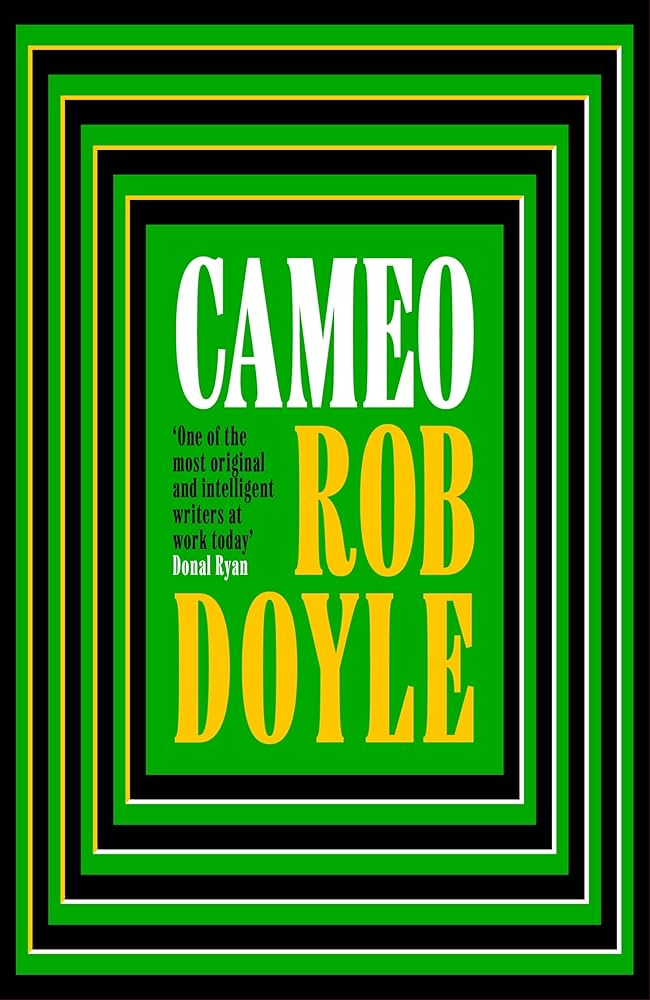
I’m a longtime fan of Rob Doyle, whose new novel Cameo came out recently. I’m also a fan of the characters named “Rob Doyle” who appear in his books: the midlife-facing, psychedelics-experimenting Rob of Threshold, and the somewhat younger “frazzled drifter called Rob Doyle” in This is the Ritual.
In this interview, carried out over a Paris-to-Dublin video call, Rob (the real one, I assure you) explains his obsession with Henry Corbin’s 1969 book Alone with the Alone: Creative Imagination in the Sufism of Ibn Arabi — where it came from, what it means, and how its revelatory concept of the ‘imaginal realm’ led to him joining a society for the first time.
Seb: Maybe we could start at the beginning. When did you first encounter Henry Corbin’s Alone with the Alone: Creative Imagination in the Sufism of Ibn Arabi?
Rob: At the start of 2025, I went to Istanbul for a few weeks. I’d never been. I just wanted to explore somewhere new, and I ended up having an exquisite time there, but the main highlight was my encounter with the mosques. Have you been to Istanbul?
Seb: Never.
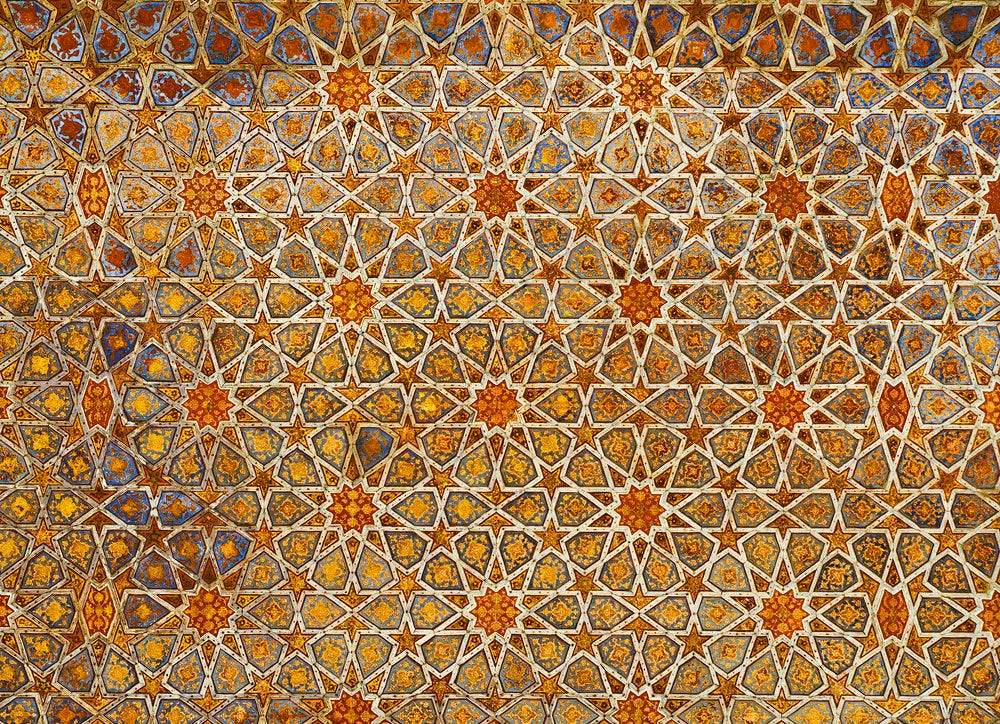
Rob: It’s such a fascinating place. I was staying on the Asian side of the Bosphorus. Every day I crossed the river on the ferry and you’d see the grand mosques of Ottoman Turkey on the horizon as you approached the city. Then I’d visit them. I’d never really spent serious time in a Muslim country before and, frankly, it beguiled and enchanted me. It gave me this whole other appreciation for Islam — for the exquisite beauty, elegance, and sophistication. What I found so awe-inspiring about these mosques, many designed by Sinan, the great sixteenth-century architect, was their non-representational approach: gestures toward the divine, the absolute. I grew up in this Christian tradition which I abandoned pretty early on — because, I don’t know, I got into reading existential philosophers, Marx and Nietzsche and all of that, and I was like, yeah, fuck all that stuff. But part of what made it seem a bit naff to me, even from an early age, is that you go into a church and you’ve literally got a bearded patriarch figure up on the roof looking down on you. For me there was never much mystique, never much transcendence. It was too mundane. In Islam, you’ve got calligraphy and you’ve got geometry.
I’d struggle to pin down what my beliefs even are. It’s not a question I’m massively interested in asking. But those calligraphic forms — that sense of elegance, harmony — and the atmosphere in the mosques really enchanted me. In my early twenties, coming through a brutal phase of life — mental problems, depression, all of this — I had a life altering encounter with Buddhist philosophy and metaphysics. That was a great source of nourishment for me and still is. And in Istanbul I realised Islam had something running through it that I’d been totally ignorant of.
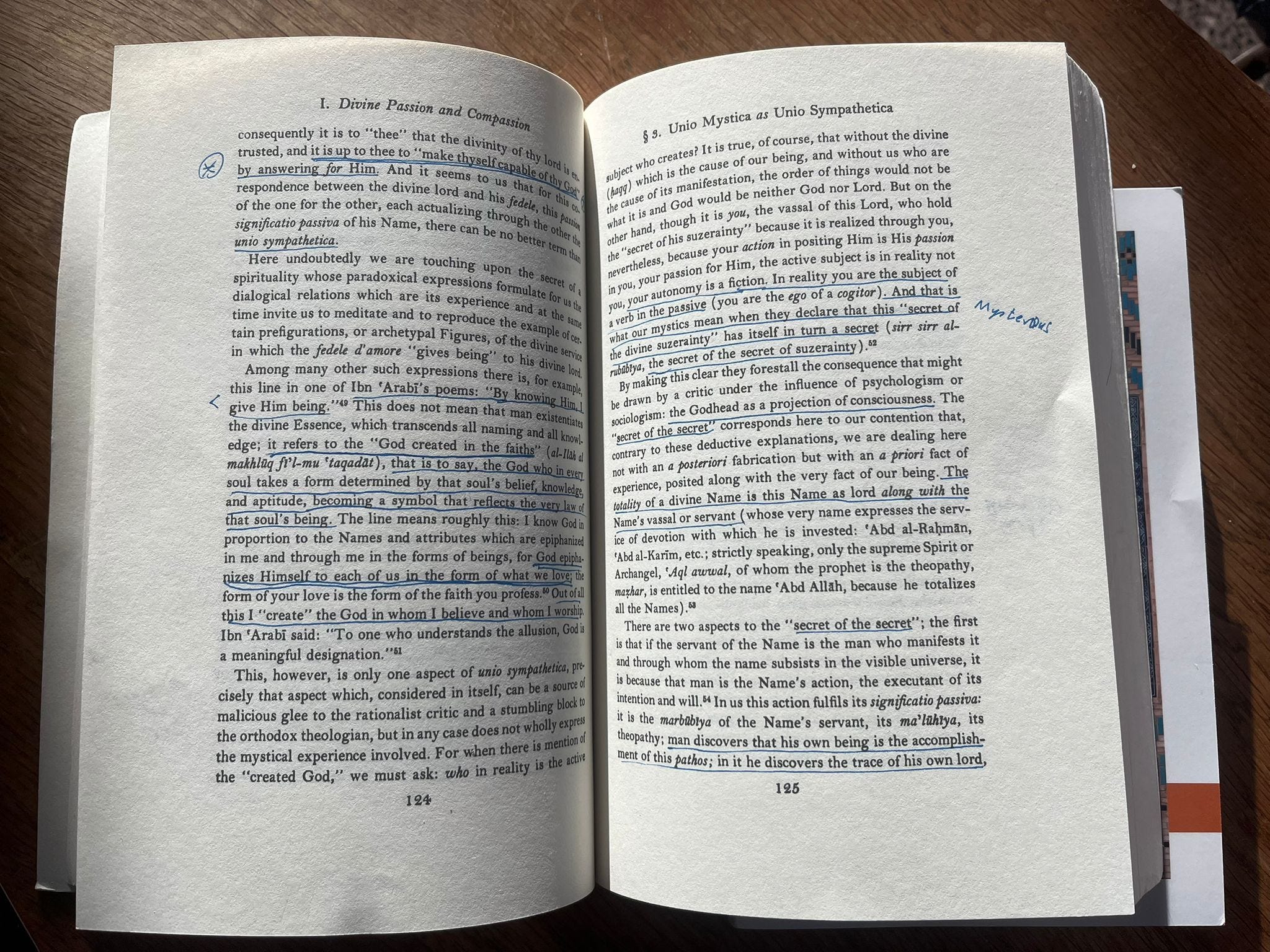
In the meantime, I’d been hearing about this guy, Henry Corbin, a 20th century French scholar of Iranian philosophy, history and so on, particularly his concept of the Mundus Imaginalis or the so-called imaginal realm. I guess that was his great contribution to modern thought, even though it was more like a revival of a centuries old concept, which was paramount in the thought of philosophers in the 12th and 13th centuries like Suhrawardi, who was a Persian Islamic philosopher, and Ibn Arabi, who was an Andalusian mystical Islamic philosopher. So Corbin apprised me of this captivating notion of the Mundus Imaginalis, the imaginal realm, which in a nutshell is a kind of objectively, ontologically real realm that exists between the familiar realm of the senses and the absolute world of the intellect. So I guess something like the Platonic realm of the forms. It’s a realm of images which are somehow free standing, a world of which the sensory world is just a pallid reflection or imitation. Anyway, this concept of the imaginal fascinated me so as soon as I got back from Istanbul, I thought, okay, I’m going to look into this guy Corbin. The first book I bought was Alone with the Alone: Creative Imagination in the Sufism of Ibn Arabi. I read it with tremendous interest. In fact, prior to talking with you, I thought, okay, I’ll give myself some time to read through everything that I underlined in the book to refresh my memory. But then I realised I didn’t give myself nearly enough time because I underlined so very much.
Seb: Was the book what you expected it was going to be?
Rob: I found it to be a profound imaginative intoxicant, a bit like reading Borges for the first time. I’m an imaginative writer. That’s what I do professionally. I write novels, stories and essays which are imaginatively infused or enhanced. So when I come at philosophy, I don’t strictly come at it looking for rational truths and so on. I’m often on the hunt for something imaginatively stimulating. I don’t really distinguish between literature and philosophy. When I read Borges or Nietzsche, it’s wonderment, it’s intoxication, it’s the dance of ideas. It’s the sense of vertigo, of an abyss, of ecstasy, all of that. And when I discovered Ibn Arabi it was as if I’d entered into a supersensible relationship with this sophisticated, mystical Andalusian sage of the 13th century — and it felt like a continuation of whatever initially drew me to the likes of Borges and Nietzsche. For the last year, I’ve read as much as I could: books by Corbin, firsthand texts by Ibn Arabi, biographies, studies. I’ve never joined a society in my life, I’ve never really joined anything, but I made one exception this year and joined the International Ibn Arabi Society. I get their journal, and over the summer my partner Roisin and I flew to London and attended the annual Ibn Arabi conference at the Warburg Institute.
The thing about Ibn Arabi is that he’s an ocean. He’s infinite. I mean, he produced an insane amount of words, 300 books or something like that. So I’m a total newcomer to it, even though I’ve read a lot of secondary texts and so on. All I can say is: my creative life is in a constant search for delight — for intoxication, exuberance, stimulation, inspiration — and you discover things, and then maybe you have dry periods, and then you discover the next things. They may be cultural, they may be artistic sub genres, or whatever it might be. But with this one, it’s almost like I discovered a lost continent, a philosophy that isn’t restricted to the terrestrial world, but compellingly posits a supersensible world and also gives a philosophical apparatus for interfacing with it, a roadmap that isn’t some new age invention of the last hundred years but is deeply rooted in a very subtle and profound tradition.
Seb: Can you give me an example of an insight that knocked you sideways? A key that you didn’t have before?
Rob: My background academically is in philosophy, which essentially means Western philosophy. I don’t know it inside out, but I’d started to feel like it had reached the end of its usefulness to me, at least in its mainstream dominant narrative. Even the great figures of the first half of my life no longer satisfied me. It was like I’d reached one of those plateaux of inspiration and it didn’t feel that they were speaking to the fullness of my experience. I’m into my forties now, and I just don’t look at things the way I did 10 or 15 years ago. Things seem so much more mysterious to me and having this philosophical category of the imaginal realm opened up a whole new way of looking at life, dreams, art, philosophy, and even the idea of a continued existence after death. I mean, if you get deep into Ibn Arabi you find this concept, which we have lost in the west, of an ‘interworld’, a realm of psyche which is not dependent on the body or the brain or the material world, which we continue to dwell in after death, And if you believe these guys, they draw terrifyingly persuasive visions of an afterlife. I also listen a lot to this podcast called Weird Studies very often where they talk about people like Henry Corbin.
Seb: How is Alone with the Alone structured? What kind of chapters are there? How does it start?
Rob: It’s a big book but the great thing about Corbin is he’s a beautiful writer. He writes gorgeous images and has a wonderful subtlety of insight. It’s as far removed from dry academic philosophy as can be imagined, but at the same time, it’s deeply erudite. Harold Bloom calls him a scholar of genius. He starts off by giving us a biography of Ibn Arabi, whose stature and importance in Islamic thought I can’t really overstate. Ibn Arabi was born in Andalusia, in Murcia. And in a way, when we talk about Ibn Arabi, we are talking about Western philosophy. He’s a Spanish philosopher. While the rest of Western Europe was a backwater, a bit of a shanty town of ideas, these guys were going at it, but I guess for reasons of prejudice, maybe, a lot of this stuff has been excised from the history of Western thought. Anyway, the first half of his life Ibn Arabi spent in the Islamic West, mostly in Andalusia. Then in the second half of his life, he went on extensive travels in the Islamic East, finally dying in Damascus in, I think it was, 1240 AD.
The rest of the book teases out and elaborates on his thought. One criticism of Corbin is that his interpretation is idiosyncratic — that actually, if you really get deep into Ibn Arabi studies, this notion of the imaginal isn’t that pronounced, that it’s actually quite minimal within the overall scope of his philosophy. But this is the concept that Corbin focuses on.
Okay, to break down in a nutshell why this stuff is so fascinating to me is that, from all I’ve learned of Ibn Arabi’s gnostic philosophy, he creates the blueprint and the framework for a truly universal meta religion. You’ve probably noticed that in the last few years, there’s been this massive surge of interest in religion, more openness in talking about religious experience, mystical experience, and so on. I find it fascinating.
Seb: Sure.
Rob: I came of age in that new atheist era — Dawkins, Hitchens — and I drank the Kool-Aid to a certain extent. Now I look back and I’m not hostile to it, just completely cold to it. I’m excited by this turn towards engaging with what lies beyond the borders of secular modernity, scientific modernity — beyond the materialistic worldview that’s held sway for a while. Although Ibn Arabi was a pious Muslim, whose thought comes from deep rootedness in Islam — and therefore in Abrahamic monotheism — for me, it’s tolerant and universal and subtle and expansive enough that it incorporates all forms of religious or mystical belief.
Seb: You talked about your early dabblings with Buddhism, and, Buddhism — rightly? Wrongly? — feels like an easier religion to dabble in. Perhaps it’s the lack of a deity. With a major monotheistic religion it feels harder to take bits and pieces. Someone like me, and I think still you, who isn’t religious in the sense of worshipping regularly or changing your lifestyle to adhere to it: you might — rightly or wrongly — be concerned, or fearful, that reading a book like this could change some fundamental aspect of who you are. If you were to buy somebody this book, it would be a heavier gift than buying them Intermezzo or Perfection or something.
Rob: Something I habitually do, every now and then, if I’m really interested in something, is post about it on Instagram. So over the last year, I’ve been splashing around a lot of Islamic content. I’m sure that makes certain people raise their eyebrows. Even my family, they’re probably going, ‘he’s going on a bit with all this Islam stuff.’ But it’s not like I’ve converted (although when I was in Berlin over the summer, I visited some mosques, which I’d never done before, and it was a really beautiful experience). I’m aware that if you start talking about Christianity or Judaism, and maybe especially Islam, people are going to be on their guard a bit, or at least people who come from the same culture as you and I do, where there’s an inherent and maybe justifiable wariness and skepticism towards the institutions which have embodied these religious traditions. But I’m just following my fascination really.
The other thing, and this is why I’m so compelled by this stuff, is the word God. I still find that word slightly embarrassing and awkward to use because it’s so loaded with all sorts of connotations. People hear it a certain way. I hear it a certain way. But when you really read the likes of Ibn Arabi, Henry Corbin, the great Sufi geniuses, the great gnostic geniuses — people who at least claim to have, but to me really have, voyaged into other dimensions of being, mapped them out, and returned to tell the tale — when they talk about God it turns out not to be what I thought it meant.
They’re talking about a reality more shocking, more infinitely mysterious. It isn’t some benign sentience in the sky. It isn’t some patriarchal father figure ruling over the cosmos, even if ancient scripture can read like that. It’s about depth — a complex way of understanding. To me, there’s a sense of vertigo when these people describe the vast architectures of being, and their conception of divinity — Allah, God, whatever we want to call it — and the place within that of human life, earthly existence, the cosmos. There’s a terror in it. It’s not even all that reassuring. The world suddenly becomes infinitely more vast and inscrutable.
I think at its lowest level, monotheistic religion — much like scientific absolutism at its most trenchant — has the sad effect of shrinking the world and spelling everything out. But at its highest level, and Ibn Arabi strikes me as somebody who was operating there, it makes the world more wondrous. You’re confronted with ever deeper mystery. The mystery itself is somehow redeeming: you realise how little you do know, but a conviction begins to form in you that isn’t just intellectual matter. What drew me to all of this stuff, if I’m being really honest, is experience. I’ve had certain experiences in the last few years, which have totally left me shocked, grasping to understand.
Seb: I find myself thinking of Threshold, and the passages about your experiences with psychedelics, especially DMT. It’s a different thing, but it was still about grasping at the unknowable, and about finding pathways to get as close to it as you can.
Rob: It’s interesting because Threshold maybe really was the threshold of something. All of the searching in that book, for the transcendent and the inexplicable, is what led me to the threshold of this new continent, this Mundus Imaginalis I’m exploring now. It almost seems like the main event, the thing that a lot of that stuff was heralding the approach of. But yeah, there’s always been this sense of philosophical restlessness. Corbin, like Ibn Arabi, describes himself as a wayfarer, a wanderer. I think he says somewhere that a philosopher should never be content to reside in a system forever, but should always be moving on to ever new vistas and horizons. Ibn Arabi was a mystic on a lifelong interior voyage into greater depths of secret knowledge but he was also a wayfarer. He never stopped at one stage for very long. The journey continued.
I guess it’s that way for me. Maybe I’ll never fully arrive, and maybe that’s okay. What would arriving mean? Death? Stasis? I don’t know. Maybe I’ll never get there.
Addenda
Cameo by Rob Doyle is out now — “a brave, risky, metafictional hall of mirrors” says the Irish Times. Rob is also on Substack.
One of my most reality-blurring metafictional experiences was reading Threshold and getting to the part where “Rob Doyle” goes to a house party of which one of the hosts is called Seb. In a sense, that Seb is me: I did once co-host a New Year’s party that Rob attended. In other ways it’s not me at all: the party in the novel takes place in October, and “Seb” doesn’t do anything except get name-checked as a host. Still — the real Rob had spent the night occupying precisely the same section of my sofa that I was now sitting on, reading about the fictional Rob. That was strange.
If you’re enjoying these interviews, and you have the means, please consider becoming a paying subscriber. If even 10% of readers upgraded, I’d be able to say no to other work more often, and do more of this instead. And if that’s not on the cards, I completely understand — a like or a share still helps, and it’s free.
oh no, this sounds like something I'm going to get obsessed with as well!